Posted on 25 February 2008 by Weefz

Age Rating:
12 (BBFC)
What is it?
A Bioware RPG witha futuristic space-colony setting and third-person-cover combat
It is fun?
Hell, yes.
Is it worth the money?
(£39.99)
Yes, yes, yes. At £1 per hour, it’s very good value for money.
Why?
I love western-style RPGs. I love sci-fi settings. And I love taking cover during combat. I love Mass Effect. This game is almost made for me :)
There are flaws. I talked about Mass Effect’s dialogue issue back in December. The inventory interface is quite possibly the worst I’ve ever seen, as is the party selection menu. Still, I had so much fun playing the game itself that I don’t really care.
The Good:
- Purpose - You have actual goals throughout the game that aren’t simply “shoot everything in sight”. Sure, that’s generally the means to your end, but at least there’s a purpose behind it.
- Combat - The combat system is great. It’s like Gears of War but less frustrating. Gears feels like you’re wearing a huge chunk of magnetic armour and everything else is made of iron. Mass Effect gives you more control when running and it’s far easier to go around things.
- Breadth - You have a giant world to explore. This isn’t a sandbox game but you can spend hours just exploring the Citadel and pick up lots of side-quests
- A useful journal! Longtime readers will know, I’m a bit fanatic about RPG journals. This one does the job, though could have done with listing the target locations more prominently. Iinstead, you’re forced to open up every single item repeatedly, to find the nearby missions.
Force powers Biotics - These mysterious powers are great fun. There’s a little something for everyone - healing, direct damage, disabling, shields, sharpshooting… I love it. None of them look quite as spectacular as KOTOR2’s Force Storm, but the combination of Lift and an assault-rifle-wielding teammate looks impressively violent.
- Advancement - I’m not sure if BioWare did a sneaky enemies-level-up-with-you but if they did, it was very subtle and much more satisfying than Oblivion. In Oblivion as you got more powerful, it never felt that way because even the lowliest grass-dwelling bandit mysteriously sprouted glass armour and would kick your sorry ass unless you specialised in combat. In Mass Effect, you can do the majority of the game in any order and it’s always challenging, but you still get the feeling of becoming more powerful.
The Bad:
- The interface and dialogue system. The interface will need a whole post to explain, so I’ll save that for another time. Just trust me, it’s rubbish.
- Uncharted worlds - These are fun to start with. The first time you get dropped on an uncharted world, it’s a breathtakingly beautiful scene. The next hundred and fifty seven times start to grate. Ultimately, the uncharted worlds all feel the same - drive around from way point to way point, drive in circles shooting something, fall off a mountain, find building, kill everyone, search back room (or for variety, upstairs back room), play unlocking mini-game, The End. But it’s the only way to get that level 50 achievement so, for some insane reason, I did them all. There’s no way I’m going for level 60 on another playthrough.
- Repetition - The endless combat in corridors for the main quest does get a little samey after a while.
- Achievements - If you collect gamerpoints compulsively, Mass Effect will swallow you for days. Assuming that you play as efficiently as possible, you’ll have to play the game all the way through twice and the middle four planets at least once more with different allies. Considering it took me around 40 hours to hit level 50 with almost all the sidequests, that’s something in the region of 80-100 hours to get all the gamerpoints. I’d advise you to rent Avatar: The Burning Earth instead, but you probably already did.
- Tower of Hanoi - Has BioWare ever made an RPG that didn’t feature the Tower of Hanoi? I’ve been solving this puzzle for at least 15 years now. I know it was in KOTOR and I’m sure I saw it in another BioWare game. Here’s a compromise; show us the puzzle and have a character ask what it is. If we answer Tower (or Towers) of Hanoi we get a free pass, okay?
In summary:
It’s a brilliant space-shooter RPG. Mass Effect would get my vote for Game of The Year 2007.
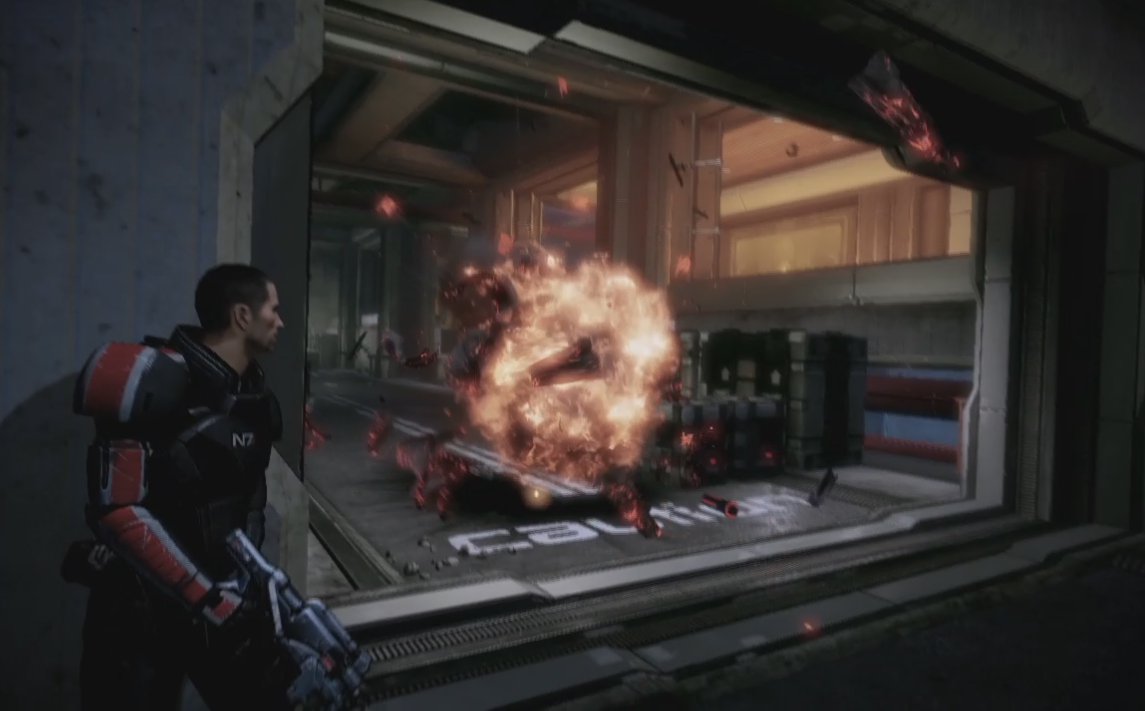
Mysteriously HUD-Free Screenshots

Popularity: 17% [?]
Posted on 10 February 2008 by TheFluffyFist
Bioware have announced that the first Mass Effect content pack called “Bring Down The Sky” will be released on Xbox Live Marketplace at 7am on the 10th March 2008. It will cost 400 Microsoft points.
So what do you get for your points:
- ~90mins of game play
- 1 new achievement (worth 50 gamerpoints)
- 1 new uncharted world
- 1 new alien race - The Batarians
- Millions of innocent citizens to save
However, in order to access this new content (planet) Commander Shepherd must be in command of the Normandy spaceship. For this you will need a save game either a couple of hours from the start (or end) of the game. I know Weefz usually has about a bazillion different saves on every game she plays (if the game allows it), so she’ll be fine. I expect that future content packs will also have the same prerequisite; a (working) spaceship.
Look out for Weefz’s forthcoming review of Mass Effect.
Popularity: 7% [?]
Posted on 23 May 2007 by Weefz
Here we are at the conclusion of my post series on computer RPG journal design. I will admit, I am a usability freak. The one thing that will wind me up faster than anything on earth is software design that isn’t based around the user. This website makes my skin crawl.
Please, cRPG designers, think about the journal early in your game design. Unless your game has all the complexity of Doom 3, a journal can make or break your game. Here is your cut-out-and-keep checklist of things to consider:
General Points:
- Hired genre-appropriate writer?
- Logged all known quests?
- Category: Trailheads
- Category: Quests in progress
- Category: Quests completed
- Category: Quests on the backburner
- Category: Quests’ area
Quest-specific points:
- Logged all details given in dialogue?
- Logged information source?
- Logged information source location? (if known)
- Logged promised reward? (if known)
- Logged what player has already done?
- Logged where player should go next? (if known)
- Logged known map locations?
- Logged visited vs. unexplored areas?
- Logged acquisition of unique quest object?
- Logged loss/discard and location of unique quest object?
Click on each item to get the detailed explanations. Do you think I’ve missed anything? Do you disagree? Let me know.
[HRODC website found through Experts Exchange]
Popularity: 4% [?]
Posted on 10 May 2007 by Weefz
This is the fifth part in my ongoing series of articles detailing the essentials to consider when writing a journal for a computer-based role-playing game. The previous parts are:
Inventory
When I pick up an as-yet-unrevealed quest item, please please please, log it in the journal. I can’t stand it when you find odd items like A Toothbrush with no clue as to its importance. I learned my gaming habits from playing Steve Meretzky games. Did anyone else get caught out by leaving the screwdriver back in Arthur’s house in Hitchhiker’s Guide To The Galaxy? Or have their Simpleberry Bush confiscated in Spellcasting 201: The Sorceror’s Applicance? Growing up with those games has left me with a healthy inventory-centric paranoia.
Continue Reading
Popularity: 9% [?]
Posted on 21 January 2007 by Weefz
This is the second in a series of posts that attempt to deconstruct the humble computer RPG journal. Other posts in the series are:
RPGs are about a story, a world and your place within that world. In such a non-linear environment, the entire user experience of the story centres around two things - 1) the journal, and 2) the way people treat your character. This post is about the importance of journal structure.
Categorise Everything
Gamers have jobs. Gamers have kids. A lot of us just don’t have the time or inclination to work through pages of chronologically-ordered diary entries hunting for that elusive clue that we overlooked the first time.
That’s what computers are for.
As I said previously, keep the journal entries for finished quests separately from the unfinished ones. Keep the entries for ongoing quest A away from the entries for quest B. Make it easy for the player to find the entry they’re looking for.
This can all be done in a fairly small and simple interface, thanks to the worldwide familiarity of hypertext. It’s handy, that Internet. Failing that, use tabs. Click on headers. I don’t care. Just keep it simple. Continue Reading
Popularity: 13% [?]
Posted on 17 January 2007 by Weefz
This is the first in a series of posts that attempt to deconstruct the humble computer RPG journal. Other posts in the series are:
RPGs. Role Playing Games. Games where the emphasis is on role-playing and story, choosing what missions to complete and how you complete them.
By their very essence, computer RPGs are complex. You can have five or more different tasks to juggle at the same time and for each task you can choose to do them a different way in order to achieve a different outcome. Gee, what would be useful to keep track of this? Why, a journal of course. How convenient that the game developers provided one for me. Now I don’t need to write everything down and lose it because the game will keep track of all the details, right?
Wrong.
Continue Reading
Popularity: 11% [?]
Posted on 30 March 2006 by Weefz
I’m a PC gamer. We have more than 101 keys. We have mice. We have high-resolution monitors. We have a long, long history of RPG interfaces being progressively refined for usability from the crappy-looking Gold Box games to the Ultima series, through Baldur’s Gate 1 and 2, Dungeon Siege and Morrowind. So why the FUCK have we been shafted with an interface designed for a 12 button controller?
Continue Reading
Popularity: 42% [?]